
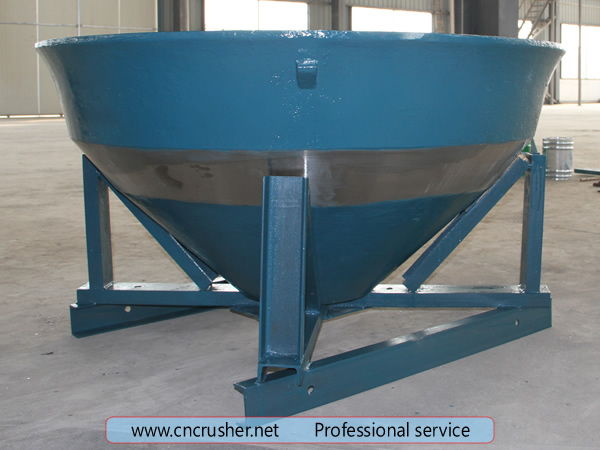
High manganese steel concave, mantle, bowl liner
Material grades
| Grade | C% | Mn% | Cr% | Mo% | As-cast HB | Work-hardened HB |
| Mn13Cr2 | 1.1–1.3 | 13–14 | 2.0 | — | 200–220 | 450–500 |
| Mn18Cr2 | 1.2–1.3 | 18–19 | 2.0 | — | 200–220 | 500–550 |
| Mn21Cr2 | 1.2–1.4 | 21–22 | 2.0 | — | 210–230 | 520–570 |
| Mn21Cr2Mo | 1.2–1.4 | 21–22 | 2.0 | 0.5–1.0 | 220–240 | 550–600 |
Work hardening
Manganese steel starts at ~200 HB as-cast. Under impact, the surface layer transforms to martensite — hardness climbs to 500+ HB while the core remains ductile. The part gets harder the longer it runs. No brittleness — the austenitic structure absorbs impact energy without cracking.
Application guide
Mn13Cr2 — Standard grade. Medium-wear applications: limestone, dolomite. Lowest cost per ton for soft to medium rock.
Mn18Cr2 — Higher manganese extends work-hardening depth. Granite, basalt, quartzite. Most common grade for cone crusher liners.
Mn21Cr2 — High manganese for maximum wear layer thickness. Abrasive ores, iron ore, copper ore.
Mn21Cr2Mo — Molybdenum addition improves yield strength at temperature. High-impact, high-abrasion conditions. Gyratory crusher concaves, primary jaw plates.
Casting and heat treatment
Sand cast. Poured at 1,380–1,420°C. Slow-cooled in the mold to 315°C, then transferred to a preheated oven (260°C). Ramped at 40°C/hr to 650°C, held (1.5 hr × max thickness in inches), ramped to 1,100°C, held again, then water-quenched. UT inspection before machining.
Compatibility
Symons 2ft–7ft | Metso HP100–HP800, GP11–GP550, MP800–MP2500 | Sandvik CH420–CH890, CS420–CS660 | Minyu MCC/MSP series | Telsmith SBS 38–68 | OMNICONE 937–1560 | Gyradisc 36"–84"
Provide your machine model and part number for a quote.